Between 21 September and 22 October my agent line merged 103 changes. 23 merged on their own. The other 80 waited for a person to read them. Model fees for all of it: $278 at list prices (all measured).
Merging by hand took me about 20 hours, at 15 minutes a merge (assumption: I have not timed it yet). That gap is what this post is about. If you run software delivery for clients, you have probably felt the same gap in your tech leads' calendars.
By "line" I mean a production line for software: agents, code and people, each with a fixed part. Its rules and memory live in a vault, a folder of markdown notes in git. My line builds one product, e-šolstvo, a platform for parents, with one operator. Most numbers come from its run logs between 21 September and 22 October 2026, read on 22 October.
How an AI system thinks
Every model, even the best one, has a limited context window. Inside one session it reasons well: it reads code, plans a change, writes it and explains what it did. When the session ends, it forgets all of it. It does not know what you decided last week, and you cannot trust its own report of what it checked.
A bigger model does not remove this limit. A system around the models does: each window gets only what it needs for one step, and hands its result to the next in a form that code can check. When these hand-offs are the same every time, they become repeating patterns of communication between agents, code and people. Connected, those patterns are a process line for product development. Connect the line to the company's decision tree, and every ticket knows which decision stands above it.
So an agentic AI system is mostly the structure around the model: the files it reads, the plan it follows, the agents that check it, the clock that starts it and the people who decide. That is where most of the engineering is, and, I will argue, most of the value. Writing code got cheap. Checking it did not. Faros AI's 2025 research found that developers on teams with high AI adoption merge 98% more pull requests, and that review time goes up 91% (outside).
Here is that structure in five parts, from one agent's mind to a whole company. Each part comes with a rule I hold and the scar that taught it.
1. The brain lives outside the model
Rule: the model's own memory is the least trusted source in the building.
The brain of my line is the vault. A model does not remember. Code tells it what it needs to know about the past, and code stores what it learned.
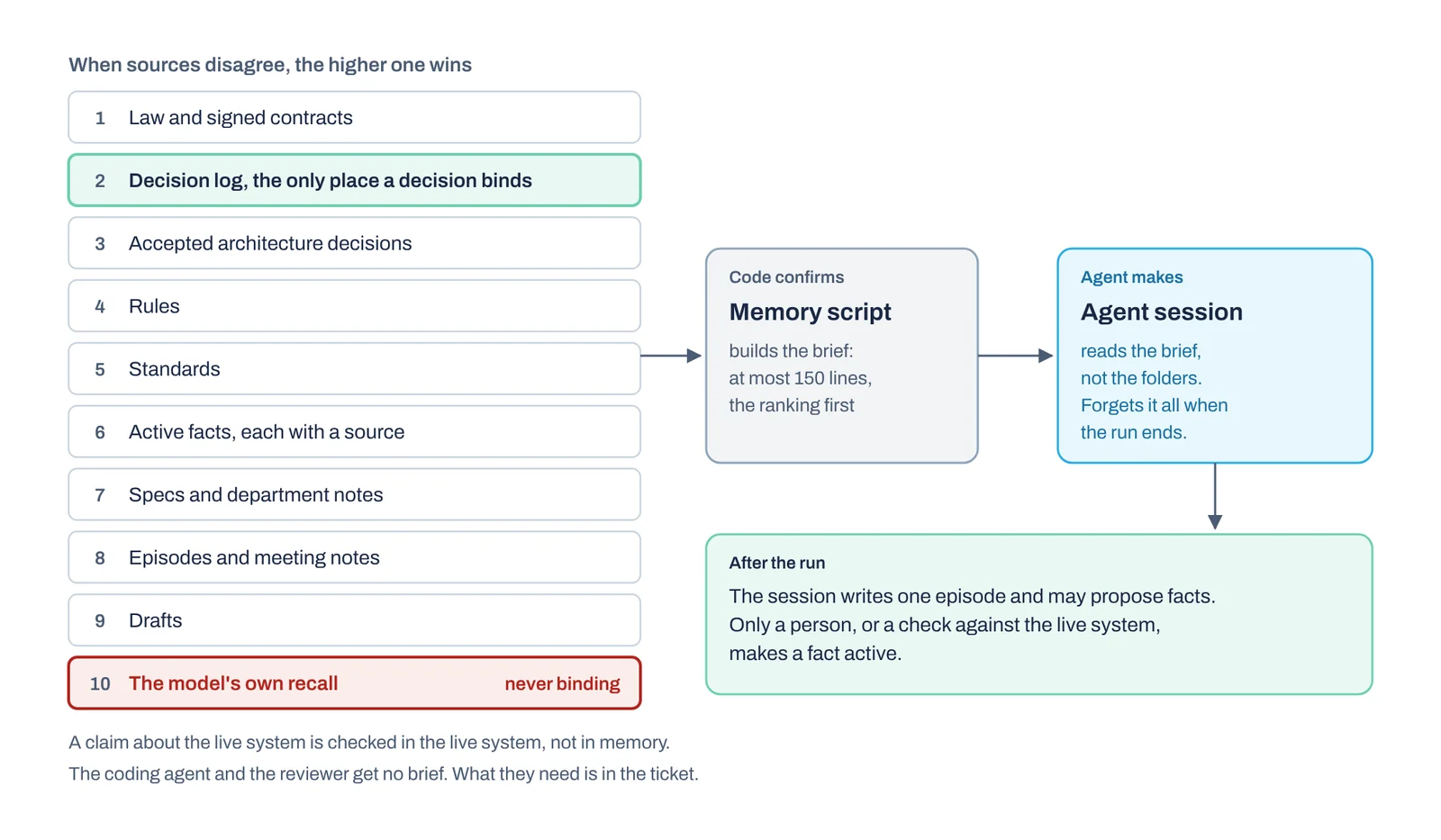
Before each run of an agent that uses memory, a script writes it a brief of at most 150 lines. The brief holds the ranking of sources, open conflicts, the facts that match the task, the procedures that worked and the agent's last episodes. The agent reads the brief, not the folders. Memory has five layers: working, episodic, semantic, procedural and forgetting. Agents may add episodes and propose facts. Only a person, or a check against the live system, makes a fact active. On 6 October the line held 67 active facts and 41 proposed ones (measured).
When two sources disagree, a ranked list decides. The law and signed contracts come first, then the decision log, then architecture decisions, rules and standards, down to drafts. The model's own recall comes last, and it never binds.
That rule has a scar behind it. My assistant's project memory once said a decision was still open. The decision log had it accepted (recorded). The model was not broken. It was the lowest source in the room, and it spoke with the same confidence as the highest.
Skills are written procedures, one job per agent. The coding agent's tools sit behind a hook, a small piece of code that sees every read, write and command before it runs. Hooks may only block. A token-saving tool taught me that: within three days it was approving every command it rewrote, and it reinstalled its own hook after it was removed (recorded). Nobody saw it for days. A hook that can say "allow" is a security decision. Mine can only say "stop", and the file that registers them is closed to agent edits.
The coding agent and the reviewer get no brief at all. Everything they need is in the ticket. That is the next part.
Which models does my line run? I name them in the first meeting, with the run log open. If you run delivery at an IT firm, book 30 minutes and watch one real ticket go through the line.
Andrej Ileršič builds an agentic software line for IT firms that deliver software for clients. Before agents: more than ten years in systems engineering, DevOps and observability.
Outside figures: Faros AI, The AI Productivity Paradox Report 2025, published 23 July 2025.